
A famous quote by Warren Buffett is that “someone’s sitting in the shade today because someone planted a tree a long time ago.” For many parents and guardians, the goal of saving, investing, and planning is to ensure the financial security of their family.
Alongside the day-to-day costs associated with raising children, parents must prepare for large expenses such as childcare, healthcare, and education, as well as ensuring the children are protected in case of an unforeseen event. With proper planning, parents can not only manage the costs of raising and protecting children, but also set them up for future financial success by utilizing different savings opportunities.
The number of ways to save for children has expanded with the creation of 530A accounts by last year’s One Big Beautiful Bill Act, which are commonly referred to as “Trump Accounts.” These savings vehicles provide families with more ways to build wealth across generations, but require consideration for how they are prioritized and interact as part of a holistic financial plan.
Trump Accounts are the newest planning tool for children
The goal of these accounts is to give children a head start toward retirement savings in a tax-efficient manner, along with a government-funded contribution. They are effectively an individual retirement account (IRA) geared toward children. According to the Treasury Department, six million children are already signed up for Trump Accounts, with 1.4 million eligible for the $1,000 pilot program contribution.1 As with any new investment vehicle, it’s important to first understand the rules before considering how it can be used to support a child’s financial future.
Some key criteria for evaluating 530A accounts are:
- If a child qualifies, the initial seed-grant of $1,000 provides motivation to start saving early. Currently, children qualify if they are born between January 1, 2025 and December 31, 2028, who are U.S. citizens and have a valid Social Security Number.
- There are no earned income requirements to make contributions for a child. This creates an alternative for long-term savings that aren’t earmarked for education purposes.
- Investment options are simplified for parents and currently include a set of low-cost, U.S. equity index funds. New legislation would be required to change or expand these investment options in the future.
- Funds are unavailable for withdrawals until the child turns 18 so they’re not available to pay for K-12 education purposes.
- Withdrawals after 18 are subject to general IRA rules with 10% penalties for early withdrawals that don’t meet a qualifying reason.
- Authorized contributions from individuals and employers are allowed up to an aggregate $5,000 per year, with employers able to contribute up to $2,500 per year without that amount counting as taxable income for the employee.
It’s helpful to think of 530A accounts as vehicles that complement, rather than substitute, other savings options. After all, the most effective financial strategy is rarely built around a single investment account.
Key investment tools when planning for children
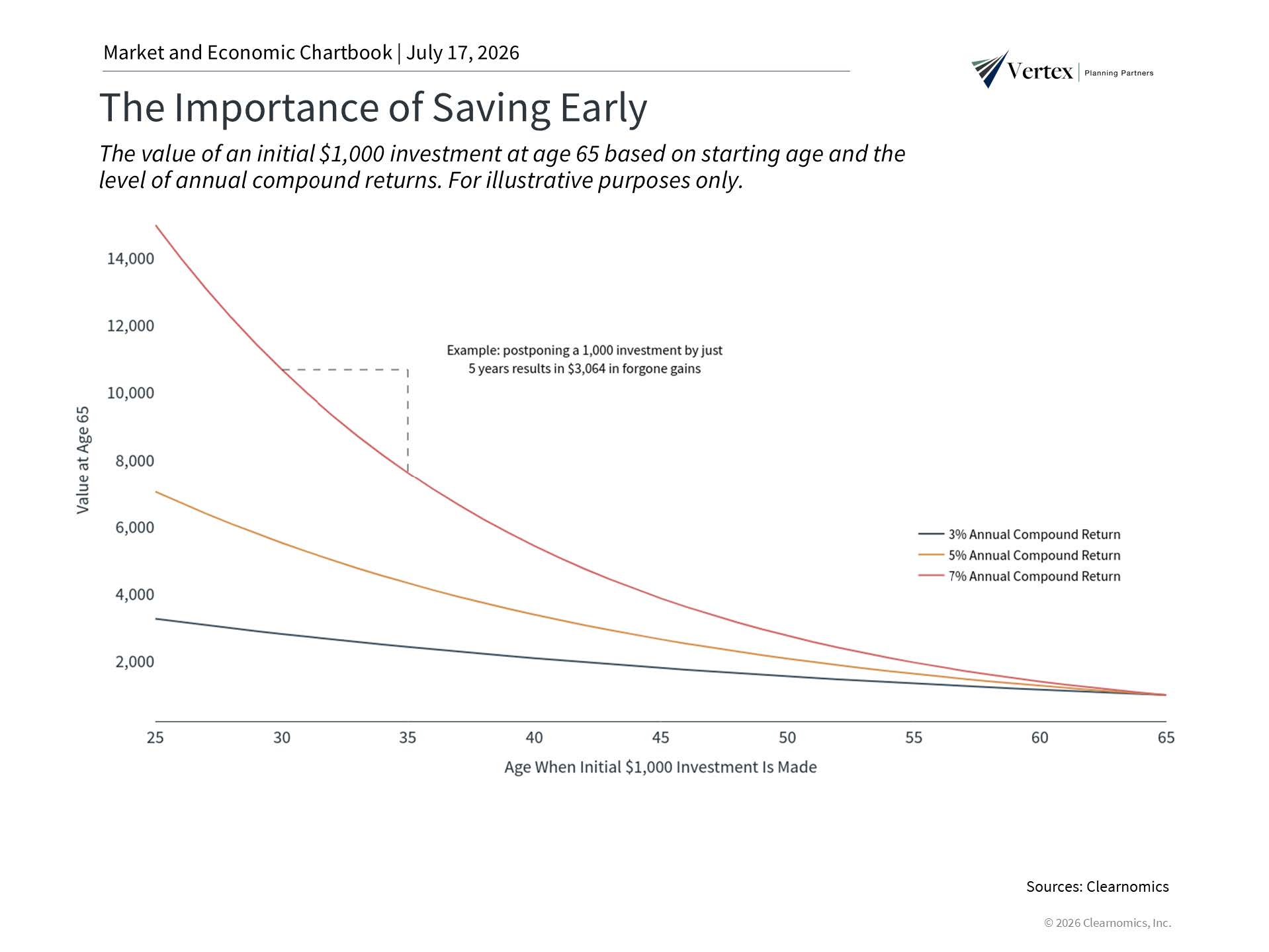 There are many child savings accounts that have become a key component of financial plans. According to data from Congress, the number of children with savings accounts rose from 1.2 million in 2021 to 5.8 million in 2023.2 The chart above shows the impact of saving even just a few years earlier.3
There are multiple ways to save for your children’s future, depending on individual circumstances, goals, and liquidity needs. Some of the most popular savings accounts are 529 accounts, custodial Roth IRAs, Uniform Gifts to Minors Act (UGMA) or Uniform Transfers to Minor Act (UTMA) accounts. All of these have different rules for contributions, withdrawals, and taxation considerations. Some important features of these accounts include:
- 529 Plans: Typically opened by a parent or grandparent and is focused on saving for future education expenses. Contributions are after-tax, and withdrawals are tax-free when used for qualified education expenses. There are no limits to contributions but they are subject to annual gifting limits.
- Custodial Roth IRA: These accounts are held in the minor’s name and geared toward retirement savings. Contributions are after-tax, and withdrawals are tax-free if conditions are met. One key difference, particularly with Trump Accounts, is that earned income is required to make contributions and the annual limit is $7,500 in 2026.
- UGMA/UTMA accounts: These accounts are also owned by the minor but managed by an adult custodian until the child reaches legal age. Its primary purpose is gifting and inheritance. No earned income is required, and contributions are after-tax and are subject to annual gifting limits.
Considerations for maximizing savings for children
There are various strategies that families can use to maximize savings while being mindful of taxes and contribution thresholds. For example, individuals are allowed to contribute a lump-sum to a child’s 529 account of up to $95,000 per beneficiary in a single year without triggering a gift tax. An important note to remember is that parent-owned 529s are not calculated as student assets for financial aid eligibility.
Another strategy is to use UTMAs to transfer highly appreciated securities. Depending on the parents’ income level, strategically gifting these securities and selling them as long-term gains in an UTMA may avoid capital gains taxes. However, a consideration is that these accounts count towards a student’s assets which are weighed more heavily in the calculation for federal student aid eligibility.
One pitfall to avoid is failing to account for “kiddie tax” which is applicable to children’s unearned income, exempt to a certain threshold. An investment below the threshold is taxed at the child’s marginal rate while the above-threshold amount is taxed at the parent’s marginal rate. This would apply to any earnings from an UTMA or distributions from the Trump Accounts.
The importance of compound growth and market returns
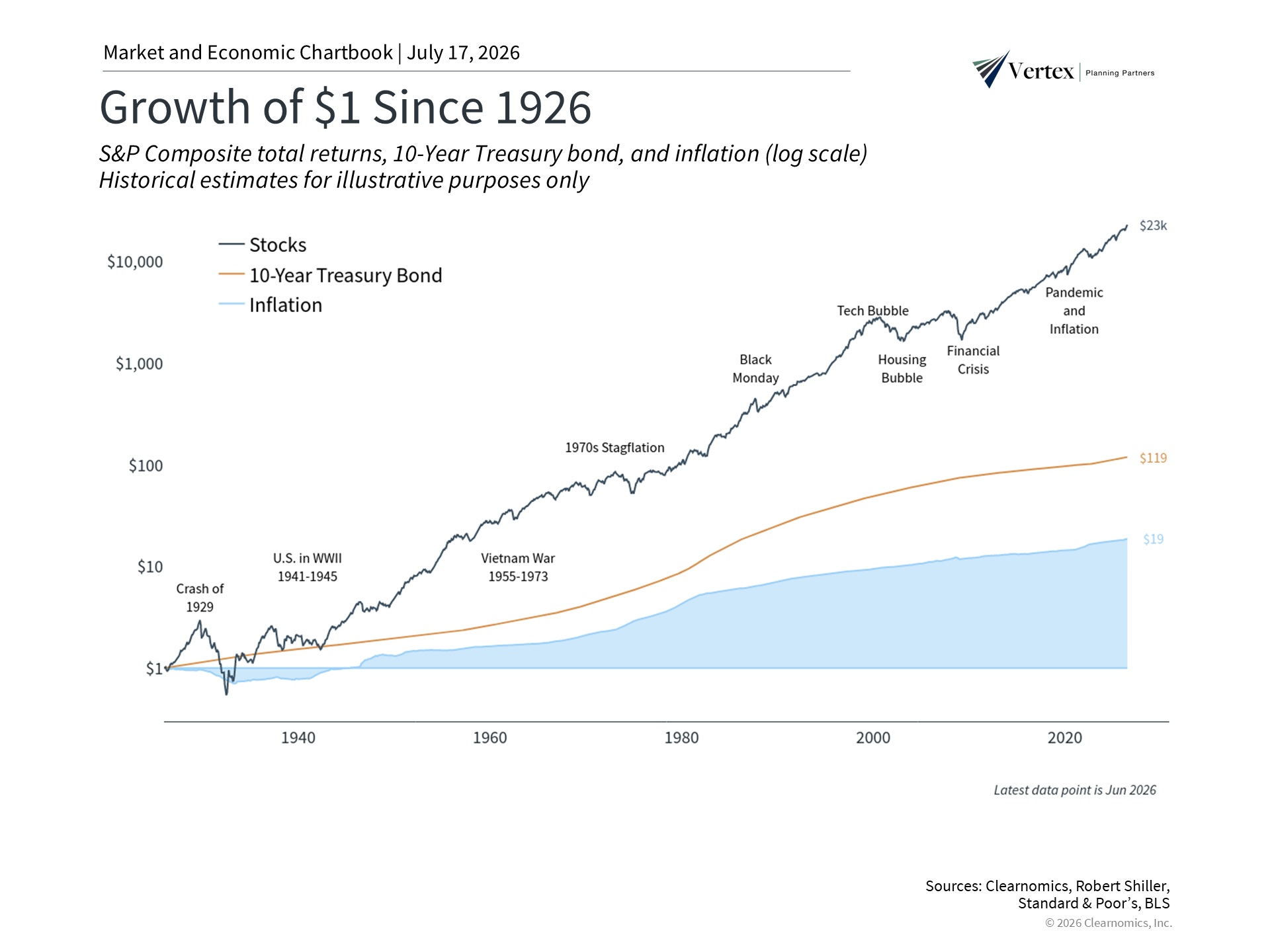 Historically, even a relatively small amount invested at birth can benefit from compound interest over a long time horizon. This is why one of the key principles of investing is to start as soon as possible to give your money time to grow. The accompanying chart shows the history of compound growth of $1 when invested in stocks and bonds over a long-term period.
Teaching children about the importance of saving money and investing early can help them become more financially responsible when they get older. Helping them further with these savings and investment accounts early, as part of a holistic financial plan, allows them to benefit from compound growth later in life.
Bottom line?
By planning ahead, parents can build a strong financial foundation for their children’s futures by utilizing savings strategies and appropriate vehicles.
References
- https://home.treasury.gov/news/press-releases/sb0552
- https://www.congress.gov/crs-product/R48554
- Clearnomics research based on historical market returns.
Index Descriptions S&P 500
The Standard & Poor’s 500 Index is a capitalization-weighted index of 500 stocks designed to measure performance of the broad domestic economy through changes in the aggregate market value of 500 stocks representing all major industries. The modern design of the S&P 500 stock index was first launched in 1957. Performance prior to 1957 incorporates the performance of the predecessor index, the S&P 90.
Content in this material is for general information only and not intended to provide specific advice or recommendations for any individual. All performance referenced is historical and is no guarantee of future results. All indices are unmanaged and may not be invested in directly.
All investing involves risk, including loss of principal. No strategy assures success or protects against loss. The economic forecasts set forth in this material may not develop as predicted, and there can be no guarantee that strategies promoted will be successful.
Copyright (c) 2026 Clearnomics, Inc. All rights reserved. The information contained herein has been obtained from sources believed to be reliable, but is not necessarily complete and its accuracy cannot be guaranteed. No representation or warranty, express or implied, is made as to the fairness, accuracy, completeness, or correctness of the information and opinions contained herein. The views and the other information provided are subject to change without notice. All reports posted on or via www.clearnomics.com or any affiliated websites, applications, or services are issued without regard to the specific investment objectives, financial situation, or particular needs of any specific recipient and are not to be construed as a solicitation or an offer to buy or sell any securities or related financial instruments. Past performance is not necessarily a guide to future results. Company fundamentals and earnings may be mentioned occasionally, but should not be construed as a recommendation to buy, sell, or hold the company’s stock. Predictions, forecasts, and estimates for any and all markets should not be construed as recommendations to buy, sell, or hold any security–including mutual funds, futures contracts, and exchange traded funds, or any similar instruments. The text, images, and other materials contained or displayed in this report are proprietary to Clearnomics, Inc. and constitute valuable intellectual property. All unauthorized reproduction or other use of material from Clearnomics, Inc. shall be deemed willful infringement(s) of this copyright and other proprietary and intellectual property rights, including but not limited to, rights of privacy. Clearnomics, Inc. expressly reserves all rights in connection with its intellectual property, including without limitation the right to block the transfer of its products and services and/or to track usage thereof, through electronic tracking technology, and all other lawful means, now known or hereafter devised. Clearnomics, Inc. reserves the right, without further notice, to pursue to the fullest extent allowed by the law any and all criminal and civil remedies for the violation of its rights.